One of the hardest questions in content marketing sounds surprisingly simple:
What should I write about next?
When you’re staring at a blank WordPress screen, it can feel like you’re supposed to pull another brilliant idea out of thin air.
So you brainstorm.
You scroll through other blogs.
You look at what people in your niche are talking about.
Maybe you even ask AI for a list of ideas.
There’s nothing necessarily wrong with any of those things.
But there’s another place to look that can be much more useful:
Your audience.
The people you’re trying to help are constantly leaving clues about what they want to know, what they’re struggling with, and what they might need next.
The trick is learning to notice them.
Your Audience Is Already Giving You Clues
Audience research can sound like something that requires expensive software, complicated surveys, or thousands of followers.
It doesn’t have to.
Especially when you’re still building your business.
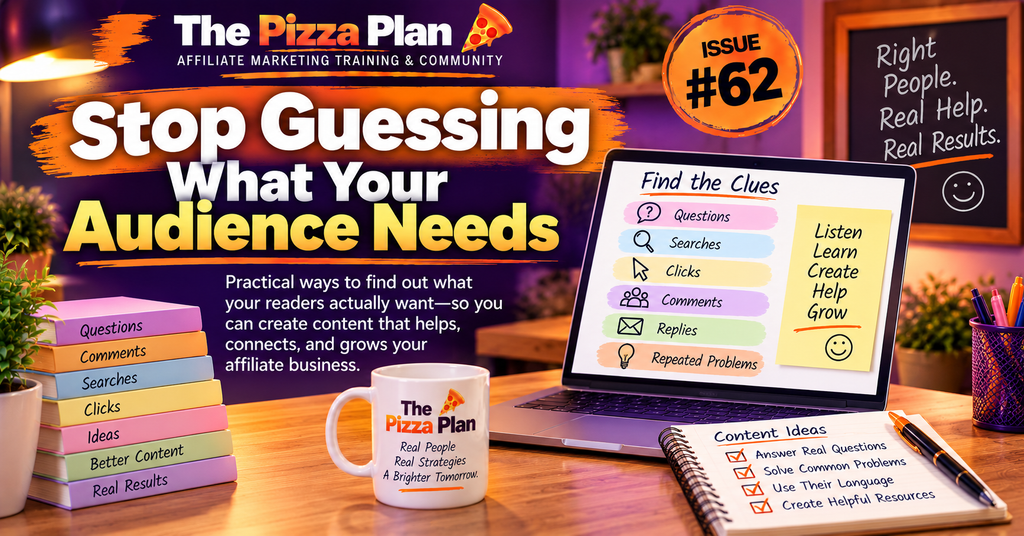
You can start by paying attention to simple things:
- Questions people ask you
- Replies to your emails
- Comments on your content
- Search terms people use
- Articles people click
- Links they don’t click
- Questions appearing repeatedly in communities you’re part of
- Problems that keep coming up in your niche
Individually, these may seem like small pieces of information.
Together, they can start showing you patterns.
And those patterns can tell you a lot about what your audience may need next.
Stop Starting With “What Should I Write?”
Try changing the question.
Instead of:
“What should I write about this week?”
ask:
“What is my audience trying to figure out?”
That’s a very different starting point.
One begins with your need to publish something.
The other begins with their need for help.
And that distinction matters.
If beginners repeatedly ask how to get traffic without spending much money, that’s a clue.
If people read your traffic articles but ignore your advanced automation content, that’s a clue.
If subscribers keep asking how to know whether an affiliate tool is worth paying for, that’s a clue.
You don’t need to guess quite as much when you’re paying attention to what people are already showing you.
Listen for Questions
Questions are one of the easiest places to start.
Suppose someone asks:
“How do I know if my affiliate links are actually getting clicked?”
You could answer that person and move on.
Or you could recognize something bigger:
If one person is asking this, other beginners may be wondering the same thing.
That question could become:
- A blog post
- An email
- A checklist
- A short tutorial
- A section in a larger guide
- A future resource
One real question can sometimes give you several useful pieces of content.
This is also why you don’t need a huge audience to learn from your audience.
A handful of genuine questions can be more useful than a large pile of vague impressions.
Pay Attention to Repeated Problems
One question is interesting.
The same type of question appearing over and over deserves more attention.
Maybe you notice people repeatedly struggling with:
- Getting traffic
- Choosing what to promote
- Understanding tracking
- Writing emails
- Knowing what content to create
- Deciding which tools they actually need
- Staying consistent without spending hours every day
Those repeated problems can help you identify the subjects worth spending more time on.
They may even point toward something bigger than another blog post.
A repeated problem might eventually justify creating a:
- Checklist
- Template
- Tutorial
- Lead magnet
- Email series
- Workbook
- Resource guide
- Paid product
But you don’t have to jump there immediately.
First understand the problem. Then decide what kind of solution makes sense.
Look at What People Do, Not Just What They Say
Sometimes people won’t tell you what they need.
Their behavior can still give you clues.
That’s where tracking becomes useful.
Look at things like:
Which articles get clicked?
Which email links get attention?
Which subjects generate replies?
Which Pinterest pins bring visitors?
Which resources get downloaded?
Where do people stop moving through your content?
None of those numbers tells the entire story.
A click doesn’t automatically mean someone loved the content.
And a post with fewer clicks isn’t automatically a failure.
But patterns over time can help you ask better questions.
For example:
Why are readers consistently choosing my beginner traffic articles over my more advanced topics?
That might tell you something about where your current audience is in their journey.
And that should influence what you create next.
Search Can Tell You Something Too
Search research isn’t only about finding keywords to rank for.
It can also help you understand the language people use when they’re looking for help.
Look at the questions that appear around your topic.
Notice autocomplete suggestions.
Pay attention to related searches.
Look at the wording beginners use in forums, communities, comments, and discussions.
You may know the technical name for something.
Your reader may be typing:
“Why aren’t people clicking my affiliate links?”
That’s useful information.
Using the language your audience naturally uses can help make your content easier to understand and easier to find.
Don’t Let Research Become Another Form of Procrastination
There is a trap here.
You could spend the next three weeks researching your audience and never create anything.
That’s not the goal.
You don’t need a 47-page customer research report before writing your next blog post.
Start small.
Create a simple place to capture what you notice.
You could keep a document or spreadsheet with headings like:
Questions
Problems
Searches
Clicks
Replies
Content Ideas
Whenever you notice something useful, add it.
Over time, you’ll build your own library of audience intelligence.
Then when it’s time to create something, you won’t always be starting from zero.
Your Existing Content Can Help You Listen
Here’s something I particularly like about building a growing content library:
Your old content can help tell you what to create next.
Suppose you have an article explaining how to get free traffic.
Readers find it.
Some click through to your article about tracking.
Then you start receiving questions about what numbers they should actually track.
That’s a natural progression.
You didn’t invent the next topic because you needed another post for the calendar.
The reader journey revealed it.
This is one reason connecting your content becomes increasingly valuable as your library grows.
You’re not just publishing individual articles.
You’re learning how one question leads to another.
Audience Research Can Improve Your Affiliate Recommendations Too
Listening shouldn’t stop when it’s time to monetize.
In fact, that’s when it becomes even more important.
If you understand what someone is actually struggling with, you’re in a much better position to decide whether a particular product or service belongs in the conversation.
Start with:
What problem does this person have?
Then:
What would genuinely help?
Only then should you ask:
Do I have a resource or affiliate offer that fits?
Sometimes the answer will be your own resource.
Sometimes an affiliate product may genuinely be useful.
And sometimes the right answer is simply another free article.
That’s okay.
The reader’s problem should lead to the recommendation—not the commission.
Try This Before Planning Your Next Piece of Content
Before deciding what to publish next, spend a few minutes looking for clues.
Ask yourself:
- What questions have I seen lately?
- What problems keep appearing?
- What content are people clicking?
- What language are people using to describe their problems?
- What have readers responded to?
- Where might they be getting stuck?
- What question would naturally come next?
Then choose one of those problems.
Create something useful around it.
You don’t need to know everything about your audience before you can help them.
You just need to start listening.
This Week’s Takeaway
You don’t have to invent every content idea from scratch.
Your audience is already giving you clues.
Questions → Comments → Replies → Searches → Clicks → Repeated Problems → Content Ideas
Pay attention to those clues.
Keep track of what you learn.
Look for patterns.
And before asking:
“What should I create next?”
try asking:
“What is my audience already telling me they need help with?”
That one change can give you better content ideas while helping you build a business around real problems instead of guesses.