Category: Foundation & Clarity

  • Issue #16 Why “More Traffic” Isn’t Always the Answer

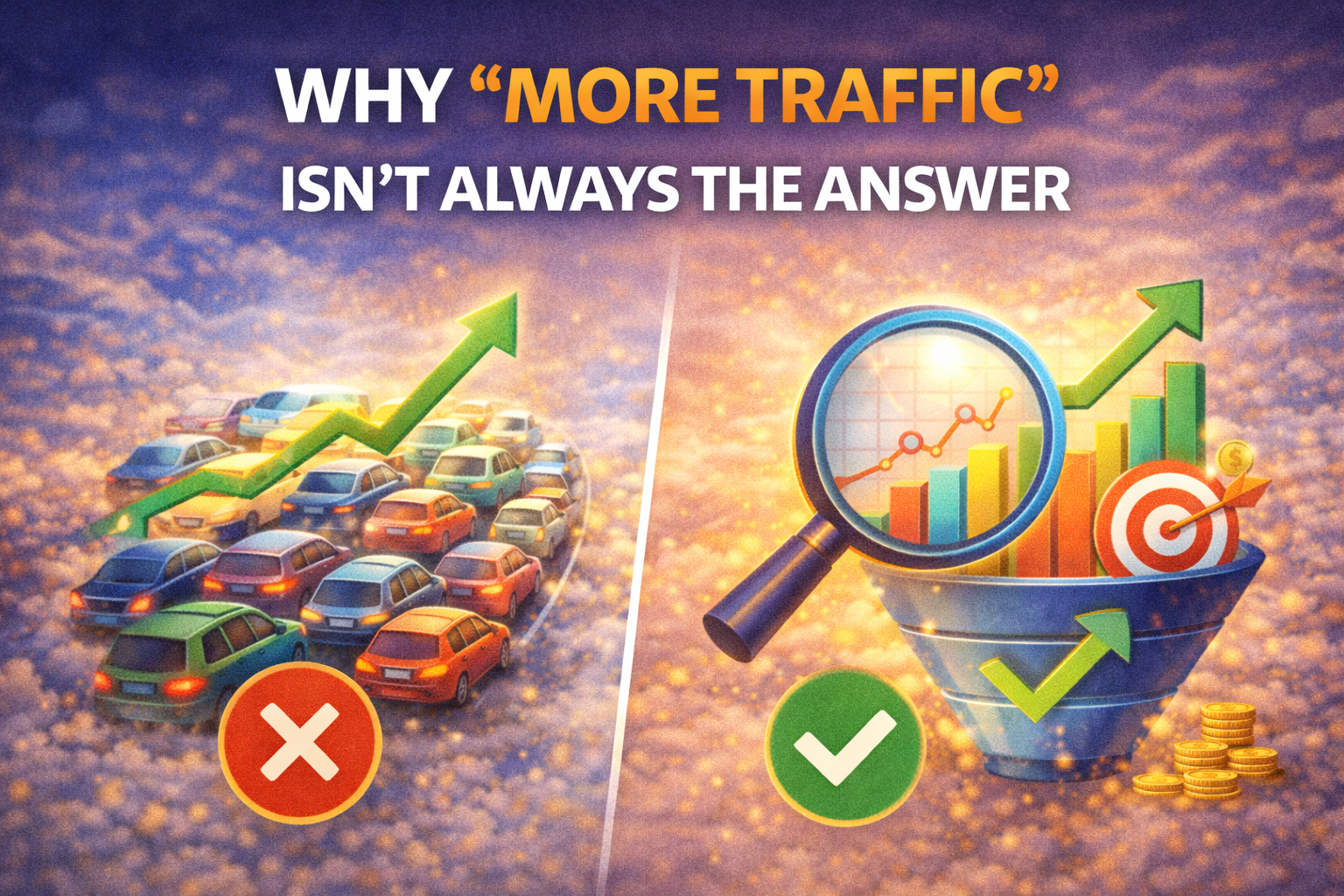
    Issue #16 Why “More Traffic” Isn’t Always the Answer

    When something isn’t working in affiliate marketing, the default reaction is usually the same:

    “I just need more traffic.”

    But more traffic doesn’t fix a broken system. In many cases, it actually hides the real problem.


    The Traffic Trap

    Early on, it’s easy to believe that volume solves everything.

    More visitors means more clicks.
    More clicks means more sales.

    Except that’s not how it usually plays out.

    If your message isn’t clear, your offer isn’t aligned, or your next step isn’t obvious, adding more traffic just sends more people away faster.


    Why Traffic Isn’t the First Problem

    Most of the time, the real issue lives before traffic:

    • The page doesn’t clearly explain the benefit
    • The offer doesn’t match the promise
    • The next step isn’t obvious
    • There’s no trust built yet

    Traffic amplifies whatever already exists. If the foundation is weak, traffic magnifies the weakness.


    What to Fix Before Chasing More Visitors

    Before worrying about traffic numbers, focus on these basics:


    1. Message Clarity

    Can someone answer this in five seconds:

    “What is this for, and why should I care?”

    If not, traffic won’t save it.


    2. One Clear Action

    Every page should answer one question:

    “What do you want me to do next?”

    Too many options lead to no action.


    3. Alignment Between Content and Offer

    If your content talks about one problem but your link solves a different one, conversions suffer.

    Traffic expects continuity.


    4. Trust Signals

    People don’t click because you asked. They click because they feel safe doing so.

    That comes from:

    • Consistency
    • Transparency
    • Relevance

    When More Traffic Does Help

    Traffic becomes powerful after the basics are working.

    You’ll know you’re ready when:

    • People are clicking consistently
    • Some visitors opt in
    • Engagement is slowly increasing
    • You can predict what happens next

    At that point, traffic fuels growth instead of frustration.


    A Better Question to Ask

    Instead of:

    “How do I get more traffic?”

    Ask:

    “What happens to people after they arrive?”

    Fix that first.


    Final Thought

    Traffic is a multiplier — not a solution.

    Build something worth multiplying, and even small traffic numbers can produce meaningful results.

    Clarity converts.
  • Issue #15 — What to Track When You’re Not Making Sales Yet

    Issue #15 — What to Track When You’re Not Making Sales Yet

    Not making sales yet?

    That doesn’t mean nothing is working.

    One of the biggest mistakes affiliate marketers make early on is tracking the wrong things — or worse, tracking nothing at all.

    When sales aren’t coming in yet, your job isn’t to panic. It’s to measure progress correctly.


    Why “No Sales” Doesn’t Mean “No Progress”

    Sales are a lagging indicator.

    They show up after several smaller actions happen consistently:

    • Someone sees your content
    • Someone clicks
    • Someone opts in
    • Someone opens emails
    • Someone starts to trust you

    If you only track sales, you miss the signals that tell you you’re actually moving in the right direction.


    What You Should Track Instead (Early On)

    Here are the metrics that matter before sales show up:


    1. Clicks

    Clicks tell you one thing: Is anyone interested enough to take action?

    Track:

    • Link clicks from blog posts
    • Clicks from emails
    • Clicks from social platforms

    No clicks = messaging problem
    Clicks but no opt-ins = page or offer mismatch

    Clicks are your first proof of momentum.


    2. Opt-Ins

    Your email list is your long-term asset.

    Track:

    • How many visitors become subscribers
    • Which pages convert best
    • Which offers attract the right people

    Even one opt-in per day adds up fast — especially when traffic is free or low-cost.


    3. Email Opens

    Opens show attention and curiosity.

    Track:

    • Average open rate
    • Which subject lines perform best
    • Whether people are opening more than once

    If people open your emails, trust is forming — even before money shows up.


    4. Replies and Engagement

    This one is underrated.

    Track:

    • Email replies
    • Comments
    • Messages
    • Questions people ask

    Engagement means your content is resonating. And resonance always comes before revenue.


    5. Consistency (Yes, Really)

    This isn’t a metric in your dashboard — but it matters.

    Track:

    • How often you publish
    • How often you email
    • Whether you’re showing up weekly

    Most people quit before the numbers ever get a chance to compound.


    What NOT to Obsess Over Yet

    Early on, avoid obsessing over:

    • Conversion percentages to the second decimal
    • Advanced funnel stats
    • Revenue comparisons with others

    Those metrics matter later — after the foundation is built.


    The Real Question to Ask Yourself

    Instead of:

    “Why am I not making sales yet?”

    Ask:

    “Are more people finding me, clicking, and sticking around than last week?”

    If the answer is yes — you’re on track.


    Final Thought

    Progress isn’t invisible — it’s just quiet at first.

    Track the small wins. They’re the breadcrumbs that lead to sales.

    Keep stacking them.

  • Issue #14 The Real Purpose of a Lead Magnet

    Issue #14 The Real Purpose of a Lead Magnet

    When most people think about a lead magnet, they think: “Something free I give away to collect emails.”

    That’s not wrong — but it’s incomplete.

    A lead magnet isn’t just about getting subscribers. It’s about starting the right relationship with the right people.


    The Common Lead Magnet Mistake

    Many affiliate marketers create lead magnets that try to do too much:

    • Too much information
    • Too many ideas
    • Too broad of a topic

    The result? You get subscribers… but not necessarily buyers or engaged readers.

    A lead magnet should never try to solve everything.


    What a Lead Magnet Is Actually For

    The real purpose of a lead magnet is to:

    • Attract a specific type of person
    • Solve one small but painful problem
    • Position you as the next logical guide

    Think of it as a bridge — not a destination.

    Its job is to move someone from:

    “I’m curious”
    to
    “I trust this person enough to keep listening.”


    The Best Lead Magnets Do Three Things Well

    A strong lead magnet:

    1. Meets people where they are
      Not where you want them to be — where they already are.

    2. Creates a quick win
      Even a small result builds confidence and momentum.

    3. Naturally leads to the next step
      The reader should want more, not feel sold to.

    If your lead magnet doesn’t point forward, it becomes a dead end.


    Simple Beats Impressive Every Time

    Checklists, short guides, swipe files, and mini frameworks often outperform:

    • Long ebooks
    • Overloaded training
    • Complicated systems

    Why?

    Because simple lead magnets get used.

    And when something gets used, it builds trust.


    A Better Question to Ask

    Instead of asking:

    “What can I give away for free?”

    Ask:

    “What’s the next logical step someone needs before they’d ever buy anything?”

    That’s your lead magnet.


    Final Thought

    A lead magnet isn’t about volume. It’s about alignment.

    When the right people join your list for the right reason, everything else — emails, clicks, and commissions — gets easier.

    Focus on clarity, not complexity.

  • Issue #13 Why Simple Funnels Beat Fancy Ones

    Issue #13 Why Simple Funnels Beat Fancy Ones

    If you’ve ever looked at another marketer’s funnel and thought,
    “I need that to succeed,” you’re not alone.

    Pages. Automations. Tags. Timers.
    It all looks impressive — but here’s the truth most beginners learn the hard way:

    Simple funnels outperform fancy ones far more often than you’d expect.

    Let’s break down why.


    The Myth of the “Perfect Funnel”

    Early on, I believed my funnel had to be complex to work.

    Multiple pages
    Long email sequences
    Advanced tools
    Monthly software bills stacking up

    What I got instead was confusion — and very little traffic converting.

    The breakthrough didn’t come from adding more pieces.
    It came from removing them.


    What a Simple Funnel Actually Looks Like

    A simple funnel usually has just three parts:

    1. One clear offer
    2. One focused page
    3. One follow-up action

    That’s it.

    No distractions.
    No unnecessary steps.
    No “maybe I’ll tweak this later” overwhelm.

    And that clarity matters — not just for your audience, but for you.


    Why Simple Funnels Convert Better

    Here’s why simpler funnels tend to win:

    • Faster setup — you can launch today, not “someday”
    • Clear messaging — visitors know exactly what to do
    • Lower costs — fewer tools, fewer subscriptions
    • Easier traffic matching — perfect for free and low-cost traffic
    • Less mental friction — which means consistency actually happens

    Most people don’t fail because their funnel isn’t advanced enough.
    They fail because they never finish building one.


    Fancy Funnels Create Hidden Friction

    Complex funnels introduce problems you don’t see at first:

    • More things to break
    • More pages to optimize
    • More decisions for visitors
    • More reasons to procrastinate

    When traffic is limited — which is true for most affiliate marketers — every extra step leaks conversions.

    Simple funnels respect attention spans.


    When Fancy Funnels Do Make Sense

    Advanced funnels aren’t bad — they’re just premature for most people.

    They make sense when:

    • You already have consistent traffic
    • You understand your audience deeply
    • You’re optimizing, not experimenting
    • You have proof of what converts

    Until then, simple wins.


    The Real Goal: Momentum, Not Perfection

    A simple funnel that’s live will always beat a fancy funnel that’s “almost ready.”

    Start with:

    • One traffic source
    • One problem
    • One solution

    Build momentum first.
    Complexity can come later — after results.


    Final Thought

    If you’re feeling overwhelmed by funnels, that’s your signal.

    Strip it down.
    Make it clear.
    Make it usable.

    Simple funnels don’t just work better — they actually get built.