Category: Tools & Systems

  • Issue #24: The Danger of Over-Automation Too Early

    Automation is powerful. It saves time, reduces manual effort, and allows you to scale faster than ever before.

    But there’s a hidden trap many founders, marketers, and creators fall into:

    They automate before they understand what actually works.

    And that mistake can quietly stall growth, burn cash, and disconnect you from your customers.

    Let’s talk about why over-automation too early is dangerous — and how to avoid it.

    The Seduction of Automation

    Today, you can automate:

    Email sequences

    Lead nurturing

    Social media posting

    Customer onboarding

    Sales follow-ups

    Content distribution

    Support responses

    With a few clicks, your business can look “fully built.”

    But looking automated and being effective are two very different things.

    Automation multiplies systems. If the system is flawed, automation multiplies the flaws.

    Why Early Automation Backfires

    1. You Haven’t Validated the Process Yet

    Before you automate, you need proof:

    Which messaging converts?

    Which offer resonates?

    Where do customers get confused?

    What objections come up repeatedly?

    If you automate too soon, you lock in guesses instead of insights.

    Manual work forces you to pay attention. Automation removes that feedback loop.

    1. You Lose Customer Intimacy

    In the early stages, direct interaction is gold.

    When you manually:

    Respond to emails

    Run sales calls

    Handle onboarding

    Follow up personally

    You gather language, objections, patterns, and emotional triggers.

    Automating too early cuts off that learning channel — and that knowledge is often what creates real growth later.

    1. You Add Complexity Before Revenue

    Automation tools come with:

    Monthly costs

    Integration headaches

    Setup time

    Maintenance

    Hidden edge cases

    If revenue isn’t consistent yet, you’re layering complexity on top of uncertainty.

    That’s not scaling. That’s building infrastructure for traffic that doesn’t exist yet.

    1. You Optimize Before You Prove Demand

    Many founders build:

    10-email nurture sequences

    Multi-branch funnels

    Complex CRM workflows

    …before they’ve even confirmed people want the core offer.

    Automation should amplify something that’s already working — not compensate for something that isn’t.

    When Automation Does Make Sense

    Automation becomes powerful when:

    You’ve manually validated the funnel

    You understand objections and buyer psychology

    Revenue is consistent

    The process is repeatable

    Bottlenecks are clearly identified

    At that point, automation becomes leverage — not distraction.

    The Right Order of Operations

    Here’s a safer progression:

    Manual First Do it yourself. Talk to customers. Test messaging. Refine.

    Document What Works Identify patterns and repeatable processes.

    Simplify the System Remove unnecessary steps.

    Then Automate Only automate what is proven and stable.

    Automation should feel like removing friction — not adding moving parts.

    A Simple Rule to Remember

    If you haven’t:

    Closed 20–50 sales manually

    Personally handled objections

    Seen the funnel convert consistently

    It’s probably too early to automate heavily.

    Manual effort builds clarity. Clarity builds conversion. Conversion earns the right to automate.

    Final Thought

    Automation is a multiplier.

    If your foundation is strong, it accelerates growth. If your foundation is weak, it accelerates failure.

    Build understanding first. Automate second.

    That order alone can save you months of frustration.
  • Issue #23 Free Tools That Actually Pull Their Weight

    Issue #23 Free Tools That Actually Pull Their Weight

    Free tools get a bad reputation.

    Some are limited. Some are clunky. Some are just stepping stones to paid upgrades.

    But here’s the truth:

    Some free tools are powerful enough to build real momentum — if you use them correctly.

    You don’t need a massive tech stack to get started. You need tools that actually pull their weight.


    What Makes a Free Tool Worth Using?

    Not all free tools are equal.

    The ones that pull their weight usually do at least one of these:

    • Solve a real problem (not just a minor inconvenience)
    • Save time
    • Replace manual effort
    • Help you validate before investing
    • Scale with you — at least for a while

    If it doesn’t help you move forward, it’s just digital clutter.


    Free Tools That Deliver Real Value

    Here are categories where free tools can genuinely support growth:

    1. Content Creation

    Free writing tools, basic design platforms, and simple video editors can be more than enough to publish consistently.

    At the early stage, consistency beats polish.


    2. Email Marketing (Starter Plans)

    Many email platforms offer free tiers that allow you to:

    • Build a small list
    • Create automated welcome sequences
    • Send broadcasts
    • Track opens and clicks

    You don’t need advanced segmentation on day one. You need subscribers.


    3. Landing Page Builders

    Some platforms allow limited free pages.

    That’s all you need to test:

    • An idea
    • A lead magnet
    • An offer

    Validation comes before upgrades.


    4. Analytics & Tracking

    Free analytics tools can show you:

    • Where traffic is coming from
    • Which pages are working
    • What needs improvement

    Data beats guessing — even basic data.


    When Free Is Enough

    Free tools are enough when:

    • You’re still validating your niche
    • You’re learning the fundamentals
    • Your traffic is low
    • You don’t have consistent revenue yet

    At this stage, your focus should be: Skill building and system building — not subscriptions.


    When Free Stops Pulling Its Weight

    Free tools stop working when:

    • Limitations slow you down
    • Branding looks unprofessional
    • Automation is restricted
    • Deliverability becomes an issue
    • You’re leaving money on the table

    That’s when upgrading becomes strategic — not emotional.


    The Real Advantage

    Free tools force you to:

    • Get resourceful
    • Focus on fundamentals
    • Build lean systems
    • Avoid shiny object syndrome

    Constraints create clarity.

    And clarity builds momentum.


    Final Thought

    You don’t need expensive tools to start.

    You need discipline. You need consistency. You need systems.

    Use free tools to build traction.

    Then let revenue fund the upgrades.

  • Issue #22 When a Tool is Worth Paying For

    Issue #22 When a Tool is Worth Paying For

    Affiliate marketers love tools.

    Email platforms. Landing page builders. Keyword research tools. AI writers. Automation software.

    The question isn’t whether tools are useful.

    The real question is:

    When is a tool actually worth paying for?

    Because not every tool deserves your money.


    The Hard Truth About Tools

    Tools don’t make money.

    They make tasks easier.

    And there’s a big difference.

    A tool only becomes valuable when it supports a system that already works—or helps you build one faster.

    If you don’t have traffic, a more expensive funnel builder won’t fix that. If you don’t have an offer, better automation won’t save you.

    Tools amplify what already exists.


    A Tool Is Worth Paying For When…

    1. It Saves Significant Time

    Time is your most limited resource.

    If a $30/month tool saves you 10 hours per month, that’s probably worth it.

    Speed compounds.


    2. It Replaces Manual Work

    If you’re copy-pasting emails, tracking leads in spreadsheets, or manually delivering content, automation can free you up to focus on growth.

    Less busy work. More leverage.


    3. It Increases Revenue Directly

    Some tools clearly impact revenue:

    • Better email deliverability
    • Improved page speed
    • Higher conversion tracking accuracy

    If it helps you earn more than it costs, it’s an investment—not an expense.


    4. You’ve Outgrown the Free Version

    Free tools are great for starting.

    But once limitations slow you down, upgrading makes sense.

    Don’t upgrade because you’re bored. Upgrade because you’re constrained.


    When a Tool Is NOT Worth Paying For

    • When you’re procrastinating with “optimization”
    • When you don’t have traffic yet
    • When you haven’t validated your offer
    • When you’re chasing features instead of results

    More features don’t equal more income.

    Better systems do.


    The Simple Test

    Before paying for a tool, ask:

    1. What specific problem does this solve?
    2. What happens if I don’t buy it?
    3. Will this help me move faster or earn more?

    If you can’t answer clearly, wait.

    Clarity first. Subscription second.


    Final Thought

    Tools are powerful.

    But only inside a working system.

    Build the system. Prove the process. Then upgrade what truly helps you scale.

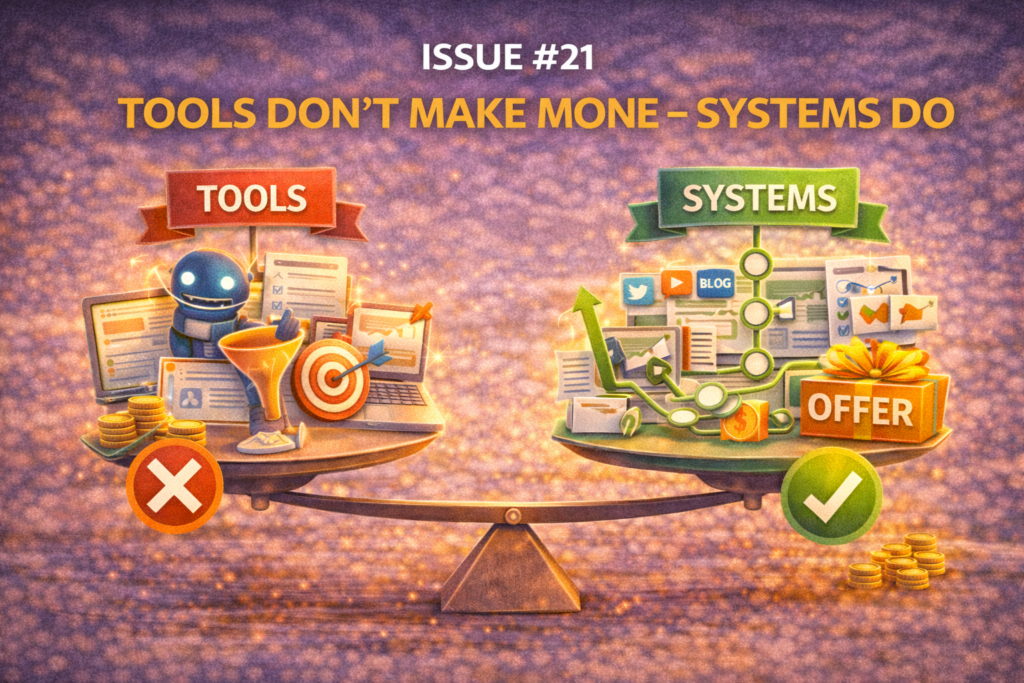
  • Issue #21: Tools Don’t Make Money — Systems Do

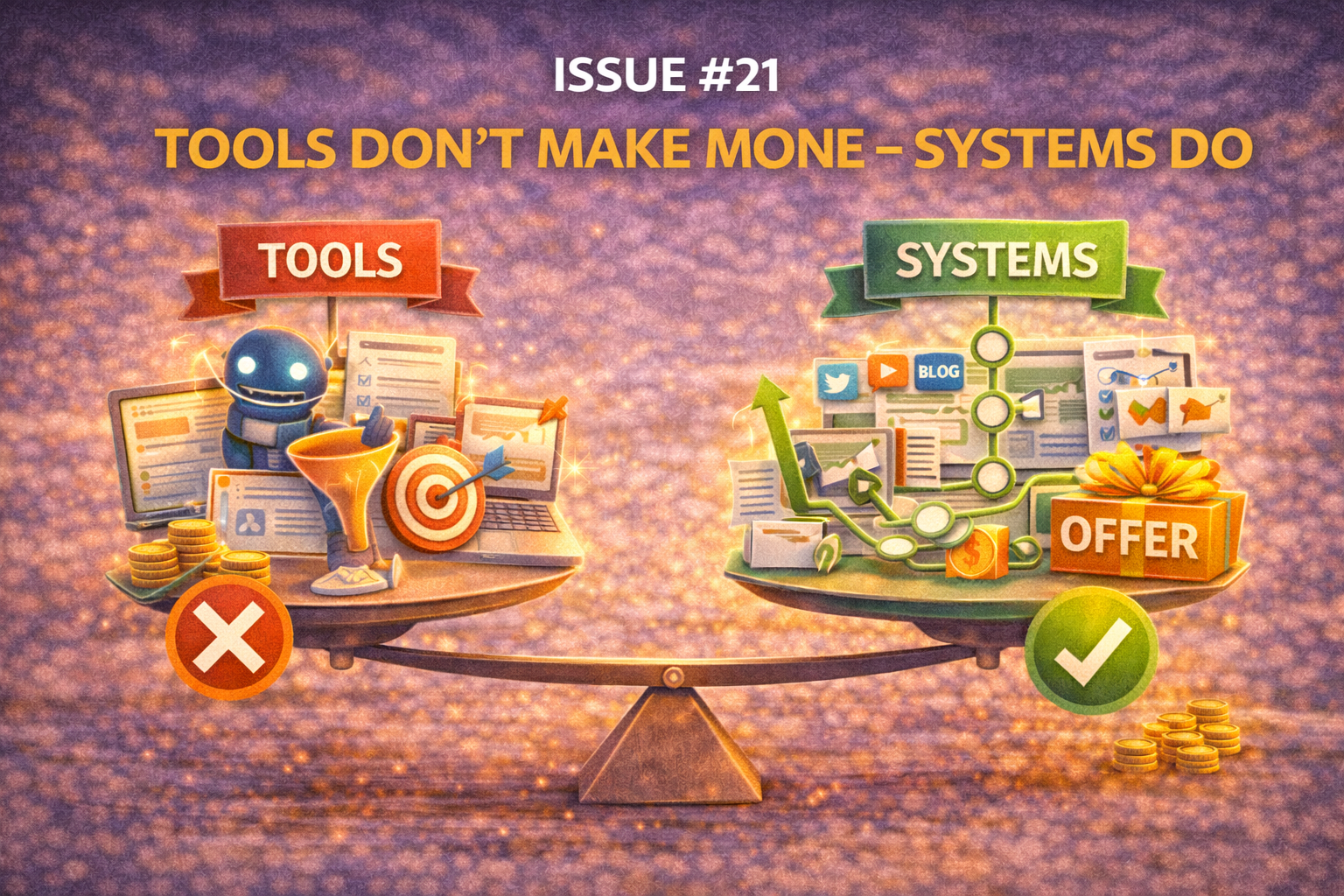
    Issue #21: Tools Don’t Make Money — Systems Do

    It’s tempting to believe the next tool will fix everything.

    A better funnel builder. A smarter email platform. A new AI writing app. A different course dashboard.

    But here’s the truth most beginners learn the hard way.

    Tools don’t make money.

    Systems do.


    The Tool Trap

    Buying tools feels productive.

    You’re setting things up. Exploring features. Watching tutorials. Organizing dashboards.

    But activity isn’t the same as revenue.

    A tool is just a container.

    Without a system behind it, it’s expensive shelf décor.


    What a Tool Actually Does

    A tool helps you:

    • Send emails
    • Build pages
    • Track clicks
    • Design graphics
    • Automate tasks

    But it does not:

    • Create strategy
    • Generate consistent traffic
    • Write persuasive messaging
    • Build trust
    • Fix unclear offers

    That part is on you.


    What a System Looks Like

    A simple affiliate marketing system might look like this:

    1. Traffic source (YouTube, blog, Pinterest, etc.)
    2. Lead capture page
    3. Email follow-up sequence
    4. Clear offer
    5. Consistent content publishing schedule

    Notice something?

    None of that depends on a specific tool.

    The tool supports the system. The system drives the revenue.


    Why Systems Win Long-Term

    When you focus on systems:

    • You stop jumping platforms
    • You stop chasing shiny features
    • You improve conversion points
    • You measure what matters
    • You build consistency

    Systems create predictability.

    Predictability creates income.


    The Real Question to Ask

    Instead of asking:

    “Which tool should I buy?”

    Ask:

    “What system am I building?”

    And then:

    “Is this tool supporting that system — or distracting me from it?”

    That one shift can save you months of wasted time and money.


    Final Thought

    The most successful marketers don’t have the most tools.

    They have the clearest systems.

    Build the machine. Then plug tools into it.

    Not the other way around.