Tag: traffic

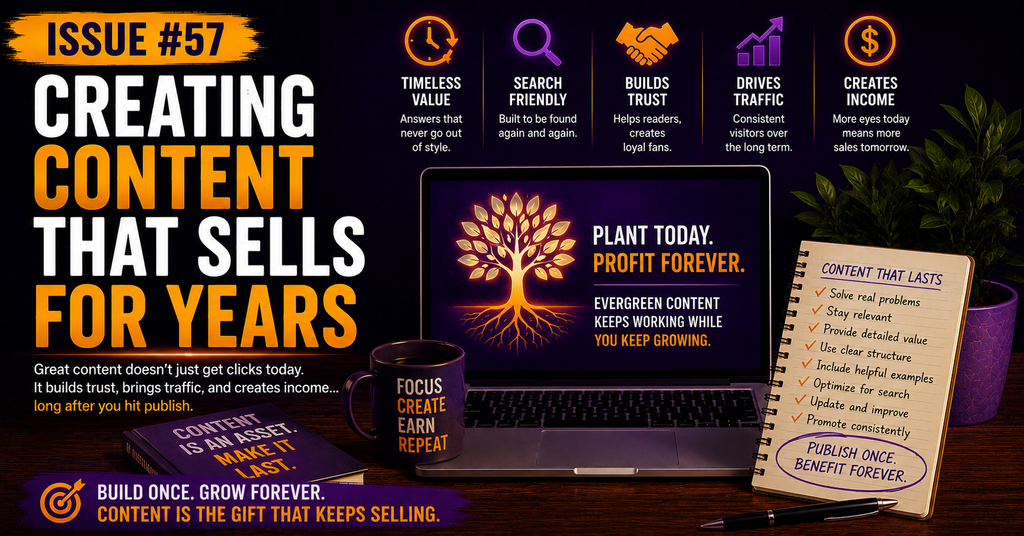
  • Issue #57: Creating Content That Sells for Years

    Imagine writing a blog post today that still brings visitors to your website two or three years from now.

    Better yet, imagine that same post continuing to introduce people to your email list, recommend useful products, and generate affiliate commissions long after you’ve moved on to creating something else.

    That’s the real potential of good content.

    In the last issue, we talked about why evergreen content wins.

    Today, let’s take that idea one step further.

    How do you create content that doesn’t just remain relevant—but can actually continue helping your business make sales for years?


    Start With a Problem That Isn’t Going Away

    Long-lasting content usually begins with a long-lasting problem.

    Think about the challenges your audience faces today that they’ll probably still face several years from now.

    For new affiliate marketers, those might include:

    • Finding affordable ways to generate traffic
    • Building an email list
    • Choosing which tools are actually necessary
    • Creating a simple sales funnel
    • Finding worthwhile affiliate offers
    • Writing content that gets clicks
    • Staying consistent without spending all day online

    Tools and platforms may change.

    But the underlying problems often don’t.

    Create content around those problems, and you’ve already given your article a longer potential lifespan.


    Don’t Just Attract Traffic — Help Someone Make a Decision

    Traffic alone doesn’t make content profitable.

    The right content helps readers move forward.

    Suppose someone searches for information about choosing an autoresponder.

    You could simply explain what an autoresponder is.

    That’s useful.

    But you could go further by helping the reader understand:

    • Why they might need one
    • Which features matter most
    • Which features a beginner probably doesn’t need
    • What free and paid options look like
    • What mistakes to avoid
    • What you personally recommend and why

    Now the article isn’t simply providing information.

    It’s helping someone make a decision.

    And decision-making content can naturally lead to affiliate sales without turning the entire article into a sales pitch.


    Create the Best Answer You Can

    If you want an article to keep working for years, don’t create it just to meet a publishing deadline.

    Make it genuinely useful.

    Ask yourself:

    If someone only read this one article about the topic, would they leave with a clear answer?

    That might mean including:

    • Step-by-step instructions
    • Examples
    • Screenshots
    • Comparisons
    • Common mistakes
    • Frequently asked questions
    • Links to additional resources

    You don’t necessarily need to write 5,000 words.

    You simply need to answer the question thoroughly enough that the reader doesn’t feel like you wasted their time.


    Match the Offer to the Content

    This is where affiliate marketing becomes much more natural.

    Instead of writing an article and then wondering where you can squeeze in an affiliate link, start with the reader’s problem.

    Then recommend a product only when it genuinely helps solve that problem.

    For example:

    An article about starting an email list could naturally introduce an email marketing tool.

    A post about building a WordPress website could naturally recommend web hosting.

    An article about generating traffic could point readers toward a traffic resource you actually use.

    The offer becomes part of the solution rather than an interruption.

    That’s a much stronger foundation for long-term sales.


    Give Readers a Clear Next Step

    Even excellent content can fail to produce results if readers don’t know what to do next.

    Don’t assume they’ll figure it out.

    Give them a logical next step.

    That might be:

    • Read another related article
    • Join your email list
    • Download a free resource
    • Try a recommended tool
    • Visit a product review
    • Start a free membership
    • Learn more about an affiliate offer

    Your call to action doesn’t always have to be:

    BUY NOW.

    Often, the better question is:

    “What’s the most helpful next step for this reader?”

    Guide them there.


    Build Trust Before Asking for the Sale

    Someone discovering your blog for the first time may not immediately buy something you recommend.

    That’s normal.

    Your content can still be doing its job.

    A reader might:

    1. Discover one of your articles through search.
    2. Read another post.
    3. Join your email list.
    4. Receive several helpful emails.
    5. Return to your blog.
    6. Eventually purchase something you recommend.

    The original article may have started a relationship that produces a sale weeks or months later.

    That’s why useful content and email marketing work so well together.


    Include Your Own Perspective

    There are thousands of articles online explaining almost any topic you can imagine.

    So why should someone read yours?

    Your experience is part of the answer.

    Tell readers:

    • What you’ve tried
    • What you use
    • What worked for you
    • What didn’t
    • What surprised you
    • What you’d do differently

    That personal perspective is something a generic article can’t easily duplicate.

    And it gives readers another reason to trust your recommendations.


    Keep Your Affiliate Links Relevant

    More affiliate links don’t automatically mean more sales.

    Sometimes they create the opposite result.

    If an article recommends six different tools for the same problem, the reader may leave wondering which one you actually prefer.

    When possible, make your recommendations clear.

    Explain why you chose something.

    Mention alternatives when they’re genuinely useful.

    But don’t turn every paragraph into another promotion.

    The content should still be valuable even if the reader never clicks an affiliate link.

    That’s what makes the recommendation believable.


    Update Your Winners

    Content that sells for years usually isn’t completely hands-off.

    Your best-performing posts deserve occasional attention.

    Every few months, check them.

    Look for:

    • Broken links
    • Outdated screenshots
    • Products that have changed
    • Pricing information that needs updating
    • New questions you could answer
    • Better internal links
    • Calls to action that could be improved

    You don’t necessarily need to rewrite the entire article.

    Small improvements can extend its useful life considerably.


    Turn One Successful Post Into a Content Cluster

    When one article begins attracting visitors or generating clicks, don’t immediately move on to an unrelated topic.

    Build around it.

    Suppose an article about email list building performs well.

    You might create additional posts about:

    • Choosing an autoresponder
    • Writing your first follow-up sequence
    • Creating a lead magnet
    • Getting subscribers
    • Improving email open rates
    • What to send your list

    Then link those articles together.

    Instead of one isolated post, you’ve created a collection of resources around a problem your audience clearly cares about.

    That can strengthen your authority while creating multiple paths toward your offers.


    Think of Content as an Asset

    It’s easy to think of blogging as something you have to keep doing every week.

    And yes, consistency matters.

    But there’s another way to look at it.

    Every quality article you publish becomes another asset in your business.

    A social media post may disappear from someone’s feed within hours.

    A useful blog article can potentially be discovered again and again.

    That’s why the effort you put into creating strong evergreen content can pay you back long after the original work is finished.


    You Don’t Need Hundreds of Posts to Start

    It’s tempting to believe you need an enormous website before content marketing can work.

    You don’t.

    Start with a smaller collection of genuinely useful articles.

    Ten excellent posts solving important problems can be more valuable than 100 rushed articles created simply to fill a publishing calendar.

    Then keep adding to the collection.

    One useful article this week.

    Another next week.

    Over time, those individual posts begin working together.


    Final Thought

    Creating content that sells for years isn’t about finding some magical headline or stuffing affiliate links into every paragraph.

    It’s about creating something worth finding.

    Solve a real problem.

    Give a complete answer.

    Share your experience.

    Recommend something useful when it fits.

    Give the reader a clear next step.

    Then keep the article updated so it continues earning its place on your website.

    Do that consistently, and your blog becomes more than a place where you publish new posts.

    It becomes a collection of assets that can attract visitors, build trust, grow your audience, and generate affiliate income for years to come.

    Create once. Keep improving. Let your content keep working.
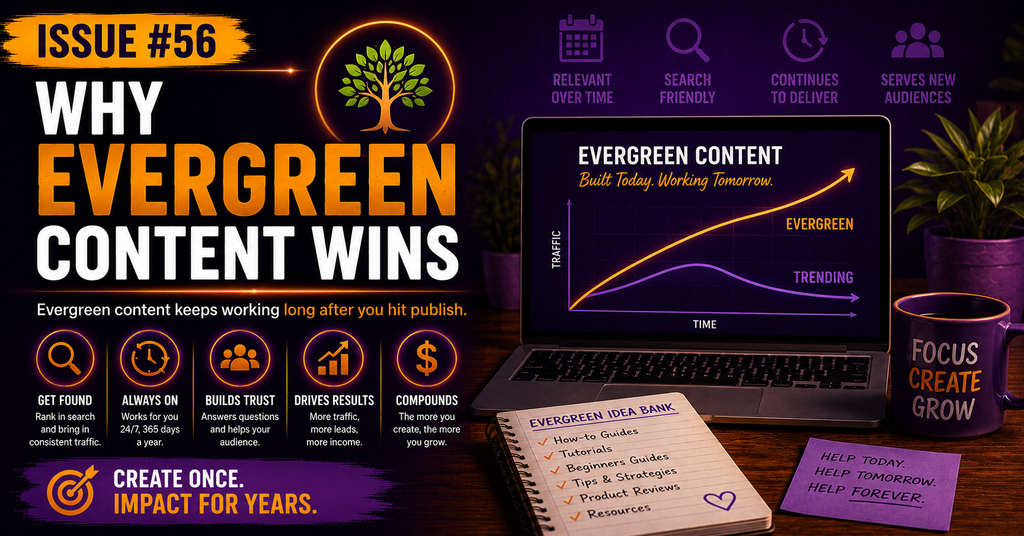
  • Issue #56: Why Evergreen Content Wins

    Some content gets attention for a day.

    Other content can bring visitors to your website for years.

    That’s the difference between content built around what’s happening right now and content built around questions people will continue asking tomorrow, next month, and next year.

    Both types of content can have value.

    But if you’re building an affiliate business with limited time and resources, evergreen content can become one of your most valuable assets.


    What Is Evergreen Content?

    Evergreen content is information that remains useful long after you publish it.

    It isn’t tied closely to a particular news story, product launch, or temporary trend.

    Examples might include:

    • How-to guides
    • Beginner tutorials
    • Frequently asked questions
    • Product reviews
    • Resource lists
    • Tips and strategies
    • Explanations of common problems

    Someone could discover the article months after you publish it and still find the information helpful.

    That’s what makes evergreen content so powerful.


    Trending Content Has an Expiration Date

    Imagine publishing an article about a big announcement happening this week.

    Interest may spike quickly.

    People search for it.

    Traffic arrives.

    Then the story fades.

    A few weeks later, very few people are searching for it anymore.

    There’s nothing wrong with creating timely content when it makes sense.

    But it often requires you to keep producing something new just to replace the traffic that disappears.

    Evergreen content works differently.


    Evergreen Content Keeps Working

    Suppose you publish a useful article answering a common question your audience regularly asks.

    Someone finds it today.

    Another person discovers it next week.

    Someone else finds it six months from now.

    The work you did once continues helping new readers.

    That article can continue:

    • Attracting visitors
    • Answering questions
    • Building trust
    • Growing your email list
    • Introducing affiliate products

    Your content becomes something that works for you, rather than something that constantly needs to be replaced.


    It’s Especially Valuable When Your Time Is Limited

    As a solopreneur, there’s only so much you can accomplish in a day.

    You can’t create content everywhere.

    And you probably don’t want your business to depend on publishing something new every few hours just to stay visible.

    Evergreen content gives you leverage.

    Instead of asking:

    “What can I publish today?”

    You can start asking:

    “What can I create today that will still be useful a year from now?”

    That’s a very different way to approach content creation.


    Search Engines Love Useful Answers

    Evergreen topics also work naturally with search traffic.

    People continually search for answers to questions such as:

    • How do I start an email list?
    • How does affiliate marketing work?
    • How can I get traffic to my website?
    • What should I look for in a web host?
    • How do I create a simple sales funnel?

    Those questions don’t disappear when a social media trend changes.

    If you’ve created a genuinely useful answer, your article has the opportunity to be discovered repeatedly through search.

    One post can potentially introduce your business to new people for years.


    Evergreen Doesn’t Mean “Never Update”

    There’s an important distinction here.

    Evergreen content can remain useful for a long time, but that doesn’t mean you should publish it and forget about it forever.

    Things change.

    Links break.

    Products change.

    Screenshots become outdated.

    Better information becomes available.

    Periodically revisit your strongest articles and ask:

    • Are the recommendations still accurate?
    • Do the links still work?
    • Can I improve the examples?
    • Is there anything important I should add?
    • Could the call to action be stronger?

    A small update can give an older article a new life.


    Build Around Problems That Don’t Disappear

    One of the easiest ways to find evergreen topics is to think about the problems your audience repeatedly faces.

    For new affiliate marketers, those problems might include:

    • Getting traffic
    • Choosing tools
    • Building an email list
    • Finding good offers
    • Managing limited time
    • Creating content consistently
    • Understanding what to track
    • Staying focused

    Those challenges aren’t going away anytime soon.

    And that means content helping solve them can remain valuable for a long time.


    Create a Library, Not Just a Feed

    There’s another advantage to evergreen content.

    Each article becomes part of a growing library.

    One post answers one question.

    Another solves the next problem.

    Another helps the reader choose a tool.

    Another explains what to do afterward.

    Over time, your blog stops feeling like a collection of random posts and starts becoming a resource people can explore.

    That’s good for readers.

    It’s good for search traffic.

    And it’s good for building authority.


    Evergreen Content Compounds

    The real power becomes visible when you stop thinking about one article and start thinking about dozens.

    Imagine having:

    10 helpful evergreen posts.

    Then 25.

    Then 50.

    Then 100.

    Each one has the potential to attract a few visitors, answer questions, introduce people to your email list, and point toward useful resources.

    You aren’t depending on one article to produce everything.

    You’re building an entire collection of small assets working together.

    That’s how content begins to compound.


    Don’t Chase Every Trend

    Trends can be tempting because they create urgency.

    Everyone is talking about something, so it feels like you should be talking about it too.

    Sometimes you should.

    But don’t let temporary trends consume all your content creation time.

    A good question to ask before publishing is:

    “Will someone still care about this six months from now?”

    If the answer is yes, you may have found an evergreen topic worth investing your time in.


    Final Thought

    You don’t have unlimited time to create content.

    So whenever possible, create something with a long shelf life.

    Answer questions people will keep asking.

    Solve problems people will continue having.

    Create resources people can discover months or years after you publish them.

    Trends can create traffic today.

    But evergreen content can become an asset for tomorrow.

    And when you’re building a long-term affiliate business, those assets can quietly keep working long after you’ve moved on to your next post.

  • Issue #32 Training Your Audience to Click

    Getting traffic is one thing.

    Getting people to take action is something else entirely.

    Because the truth is—clicking is a behavior.

    And like any behavior, it can be learned.

    If your audience isn’t clicking, it’s not always because they’re not interested…

    Sometimes, it’s because they haven’t been trained to click yet.


    Why People Don’t Click

    Most people online are in scrolling mode.

    They:

    • Skim content
    • Glance at headlines
    • Move quickly from one thing to the next

    Clicking requires a decision.

    And if your audience isn’t used to taking that next step, they’ll keep scrolling—even if your content is good.


    Clicking Is a Habit

    When someone clicks once and has a good experience, they’re more likely to click again.

    Over time, this creates a pattern:

    • They read your content
    • They expect value
    • They trust your links
    • They click more often

    This is how you build a responsive audience.


    Start With Small, Easy Wins

    Don’t expect big actions right away.

    Instead, train your audience with low-friction clicks:

    • “Read this short post”
    • “Check this quick tip”
    • “See what I mean here”

    Make the action feel simple and worthwhile.


    Deliver Value After the Click

    This is where most people lose trust.

    If someone clicks and gets:

    • Confusing content
    • Irrelevant information
    • Overly aggressive selling

    They’re less likely to click again.

    Every click should lead to something helpful, clear, or interesting.

    That’s how you build trust.


    Be Consistent With Your Calls to Action

    If you rarely include links, your audience won’t expect them.

    If you consistently guide people to the next step, they start looking for it.

    Simple phrases work well:

    • “Here’s what I recommend”
    • “Take a look at this”
    • “You can see it here”

    Consistency creates familiarity.

    Familiarity increases clicks.


    Don’t Hide the Next Step

    Sometimes people don’t click because it’s not obvious what to do.

    Make it clear:

    • What the link is
    • Why it matters
    • What they’ll get from it

    Clarity removes hesitation.


    Train Through Repetition

    You don’t train your audience in one post.

    It happens over time.

    Each piece of content is another opportunity to:

    • Guide behavior
    • Build trust
    • Reinforce the habit

    Eventually, clicking becomes natural.


    Final Thought

    Clicks don’t happen by accident.

    They happen through consistency, clarity, and trust.

    If you want more engagement, don’t just create content…

    Train your audience to take the next step.

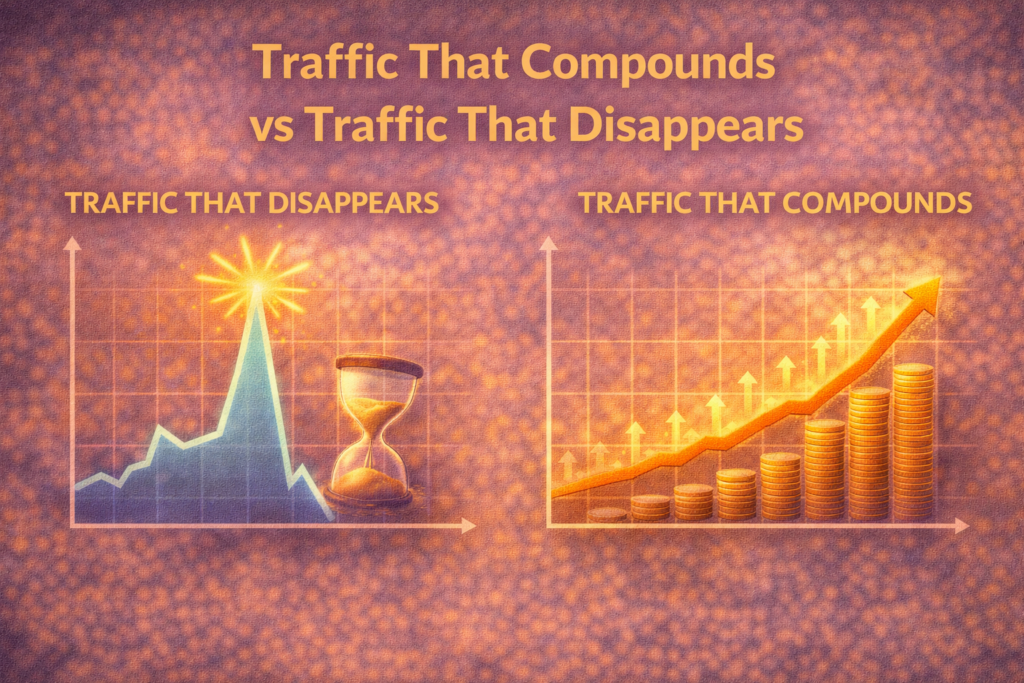
  • Issue #28 Traffic That Compounds vs Traffic That Disappears

    Not all traffic is created equal.

    Some traffic shows up once… and never returns.
    Other traffic builds over time and keeps working for you long after the initial effort.

    If you want to grow a sustainable online business, it’s important to understand the difference between traffic that compounds and traffic that disappears.


    What Is Traffic That Disappears?

    This is the kind of traffic most beginners chase.

    It comes quickly—but doesn’t last.

    Examples include:

    • Viral social media posts
    • Short-term trends
    • One-time promotions
    • Paid ads without follow-up systems

    This type of traffic can create a temporary spike in clicks or views.

    But once the post fades or the campaign ends, the traffic stops.

    You’re back to zero, needing to start again.


    What Is Traffic That Compounds?

    Compounding traffic works differently.

    Instead of relying on one moment, it builds over time through consistent effort.

    Examples include:

    • Blog posts that rank or get shared repeatedly
    • YouTube videos that continue getting views
    • Email lists that you can reach anytime
    • Content that stays relevant over time

    Each piece adds to the last.

    And instead of starting from zero, you’re building on what already exists.


    Why Compounding Traffic Matters

    Compounding traffic creates leverage.

    You put in effort once—and it continues to deliver results.

    Over time, this leads to:

    • More consistent visitors
    • Less reliance on constant promotion
    • A growing audience you can reach again and again

    It’s the difference between constantly chasing attention… and building something that attracts it naturally.


    The Hidden Problem with Chasing Disappearing Traffic

    When you rely only on short-term traffic, you fall into a cycle:

    Create → Promote → Spike → Drop → Repeat

    It becomes exhausting.

    And worse, it makes your results unpredictable.

    You might have a great day… followed by silence.


    How to Start Building Compounding Traffic

    You don’t need to abandon fast traffic completely—but you should start shifting your focus.

    Here are simple ways to begin:

    • Create content that solves ongoing problems
    • Build an email list from day one
    • Focus on platforms where content lasts longer
    • Repurpose content instead of starting from scratch

    Small, consistent actions create long-term results.


    Use Both—But Prioritize One

    Disappearing traffic can give you quick exposure.

    Compounding traffic builds your foundation.

    The goal isn’t to avoid one entirely—but to make sure you’re not relying on the wrong one.


    Final Thought

    Short-term traffic gives you moments.

    Compounding traffic builds momentum.

    If you want results that last, focus less on chasing attention—and more on creating assets that keep bringing people back.

  • Issue #27 The Difference Between Views and Clicks

    If you spend time promoting content online, you’ll often see two numbers show up in your statistics:

    Views and clicks.

    At first glance they may seem similar, but they represent two very different things. Understanding the difference can help you make better decisions about your content, traffic strategies, and promotions.


    What a View Actually Means

    A view simply means someone saw your content.

    This could be:

    • A blog post appearing in a feed
    • A social media post showing up in someone’s timeline
    • A video thumbnail appearing in search results
    • An ad being displayed on a website

    Views are about visibility. They tell you how often your content is being shown to people.

    But visibility alone doesn’t mean engagement.

    Someone can see your content without taking any action.


    What a Click Means

    A click happens when someone takes action.

    They decide to:

    • Open your blog post
    • Visit your website
    • Follow a link
    • Learn more about what you’re offering

    Clicks represent interest.

    When someone clicks, they are moving from passive viewing to active curiosity.

    That small action is often the first real step toward building traffic, subscribers, or customers.


    Why the Difference Matters

    A piece of content can receive thousands of views but very few clicks.

    When that happens, it usually means something is missing.

    Common reasons include:

    • Weak headlines
    • Unclear messaging
    • Low curiosity
    • Poor visual presentation

    On the other hand, a smaller number of views with a high number of clicks often means your message is connecting with the right audience.


    Improving Your Click Rate

    If your views are high but clicks are low, focus on improving what people see before they click.

    That includes:

    • Strong headlines
    • Clear benefit statements
    • Eye-catching images
    • Curiosity-driven descriptions

    These elements act like invitations. Their job is to encourage someone to take the next step.


    Focus on the Right Metric

    Views help you measure reach.

    Clicks help you measure interest.

    Both matter, but clicks usually tell you more about whether your content is actually working.


    Final Thought

    Getting your content seen is important.

    But the real goal is getting someone curious enough to click.

    Because once someone clicks, the real conversation begins.

  • Issue #26 Traffic Momentum vs Traffic Spikes

    If you’ve spent time promoting affiliate offers or content online, you’ve probably seen this happen:

    A post suddenly gets attention. Clicks jump. Traffic spikes.

    And then… it disappears.

    This is one of the biggest misunderstandings beginners have about traffic. They chase spikes, when what they really need is momentum.

    Understanding the difference can completely change how you approach growing your online business.


    What a Traffic Spike Looks Like

    A traffic spike is a sudden burst of visitors that doesn’t last long.

    It might come from:

    • A viral social media post
    • A popular forum comment
    • A trending topic
    • A shoutout from someone with a large audience

    Spikes can feel exciting because numbers jump quickly. But the problem is simple:

    Spikes fade just as quickly as they arrive.

    Once the attention moves on, the traffic usually drops right back to where it started.


    What Traffic Momentum Looks Like

    Momentum is slower—but far more powerful.

    Instead of one big burst, traffic grows through consistent small actions over time.

    Momentum might come from:

    • Publishing regular blog posts
    • Commenting on videos in your niche
    • Sharing helpful content in communities
    • Sending consistent emails to your list

    Each piece may only bring a small number of visitors.

    But together, they create something much more valuable: steady growth.


    Why Momentum Wins

    Momentum compounds.

    One article leads to another. One link leads to another. One reader shares your content.

    Over time you start to notice something important:

    Traffic no longer depends on one post, one platform, or one lucky moment.

    Instead, you have multiple sources working together.

    And that creates stability.


    Spikes Still Have Value

    This doesn’t mean spikes are bad.

    In fact, spikes can help you:

    • Discover which content resonates
    • Reach new audiences quickly
    • Accelerate growth when momentum already exists

    The key is understanding that spikes should support momentum—not replace it.


    The Real Goal

    Successful solopreneurs rarely rely on one viral moment.

    They focus on building systems that create traffic every day, even when they’re not actively promoting.

    That happens through:

    • Consistent publishing
    • Strategic commenting
    • Email list building
    • Helpful content

    None of these create massive spikes overnight.

    But together they create something far more powerful:

    Traffic that keeps coming back.


    Final Thought

    Spikes can feel exciting. Momentum builds businesses.

    If you’re choosing between chasing the next viral moment or consistently creating helpful content…

    Choose momentum.

    Your future traffic will thank you.


    Matching Featured Image (1200 × 628)

    I’ve created a visual illustrating a sharp spike graph vs a steadily rising momentum graph, which reinforces the concept in the post.

    Download and upload to WordPress:

    Download Image: Traffic Momentum vs Traffic Spikes

    If you’d like, I can also help you build the next posts in this series, such as:

    • #27 — The First 100 Visitors Are the Hardest
    • #28 — Why Most Traffic Advice Is Overcomplicated
    • #29 — The Simple Habit That Builds Traffic Daily

    They would continue this short, practical solopreneur strategy series you’re building.

  • Issue #25: Why Borrowed Traffic Is Still Valuable

    There’s a popular piece of advice in online business:

    “Don’t build on rented land.”

    The logic makes sense. Platforms can change algorithms. Accounts can get restricted. Reach can disappear overnight.

    But here’s the truth most people miss:

    Borrowed traffic is still incredibly valuable — if you use it correctly.

    The problem isn’t borrowed traffic. The problem is depending on it without a strategy.

    Let’s break this down.


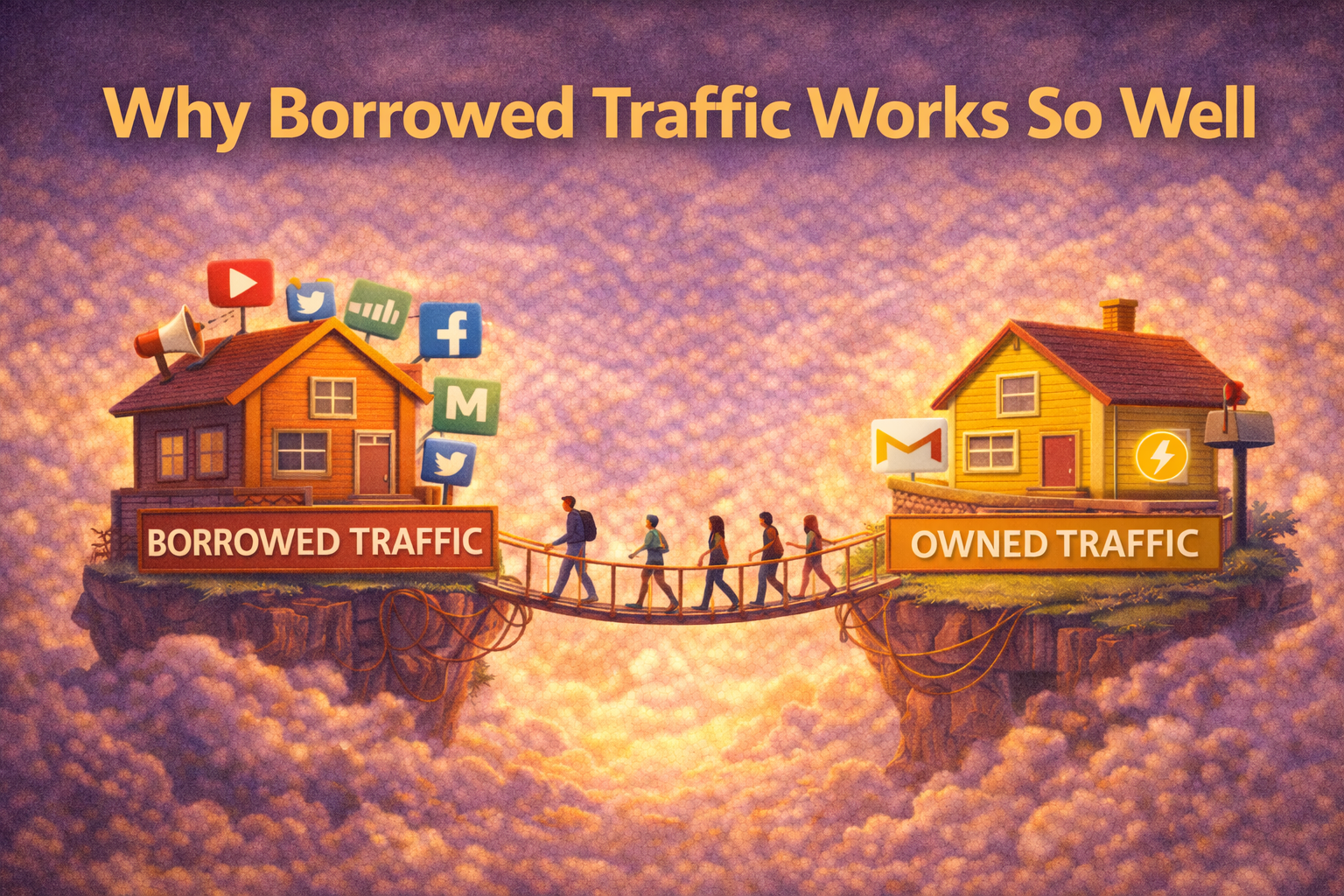
    What Is Borrowed Traffic?

    Borrowed traffic is any audience you don’t own.

    Examples include:

    • Social media platforms
    • YouTube
    • Medium
    • Marketplace platforms
    • Podcast platforms
    • Paid ads
    • Affiliate traffic

    You don’t control the platform. You don’t control the algorithm. You don’t own the audience.

    But you do get access to attention.

    And attention is the starting point of every sale.


    Why Borrowed Traffic Works So Well

    1. It Has Built-In Distribution

    Platforms already have users.

    You don’t need to build infrastructure from scratch. You’re tapping into existing demand, search behavior, and discovery engines.

    That dramatically lowers the barrier to entry.


    2. It Accelerates Validation

    If you’re testing:

    • A new offer
    • A new hook
    • A new content angle
    • A new niche

    Borrowed traffic gives fast feedback.

    You can see what resonates before committing to long-term infrastructure like SEO-heavy blog strategies or complex funnels.


    3. It Builds Authority Faster

    Early on, momentum matters more than control.

    A growing audience on a major platform creates:

    • Social proof
    • Credibility
    • Inbound opportunities
    • Brand awareness

    Even if you don’t “own” the platform, you own the positioning you build on it.


    The Real Mistake: Staying Borrowed Forever

    Borrowed traffic becomes dangerous when:

    • You never collect emails
    • You never move people to owned assets
    • You rely entirely on algorithm reach
    • You have no relationship outside the platform

    Borrowed traffic should feed owned assets.

    Not replace them.


    The Smart Strategy

    Here’s the balanced approach:

    1. Use Borrowed Traffic for Discovery Let platforms help people find you.

    2. Convert to Owned Assets Capture emails. Build a newsletter. Create a community.

    3. Deepen the Relationship Long-form content, direct communication, consistent value.

    4. Diversify Traffic Sources Never rely on just one platform.

    Borrowed traffic is the top of the funnel. Owned traffic is the long-term asset.

    Both matter.


    Why Beginners Shouldn’t Ignore Borrowed Traffic

    Trying to build purely on owned channels from day one can be painfully slow.

    No one reads a brand-new blog with no traffic. No one joins a newsletter they’ve never heard of.

    Borrowed traffic solves that visibility problem.

    It gives you leverage before you have reach.


    Final Thought

    Borrowed traffic isn’t the enemy.

    Dependency is.

    Use platforms to grow. Use owned assets to sustain. Use both to build stability.

    The goal isn’t to avoid rented land. The goal is to build a house you can eventually move people into.

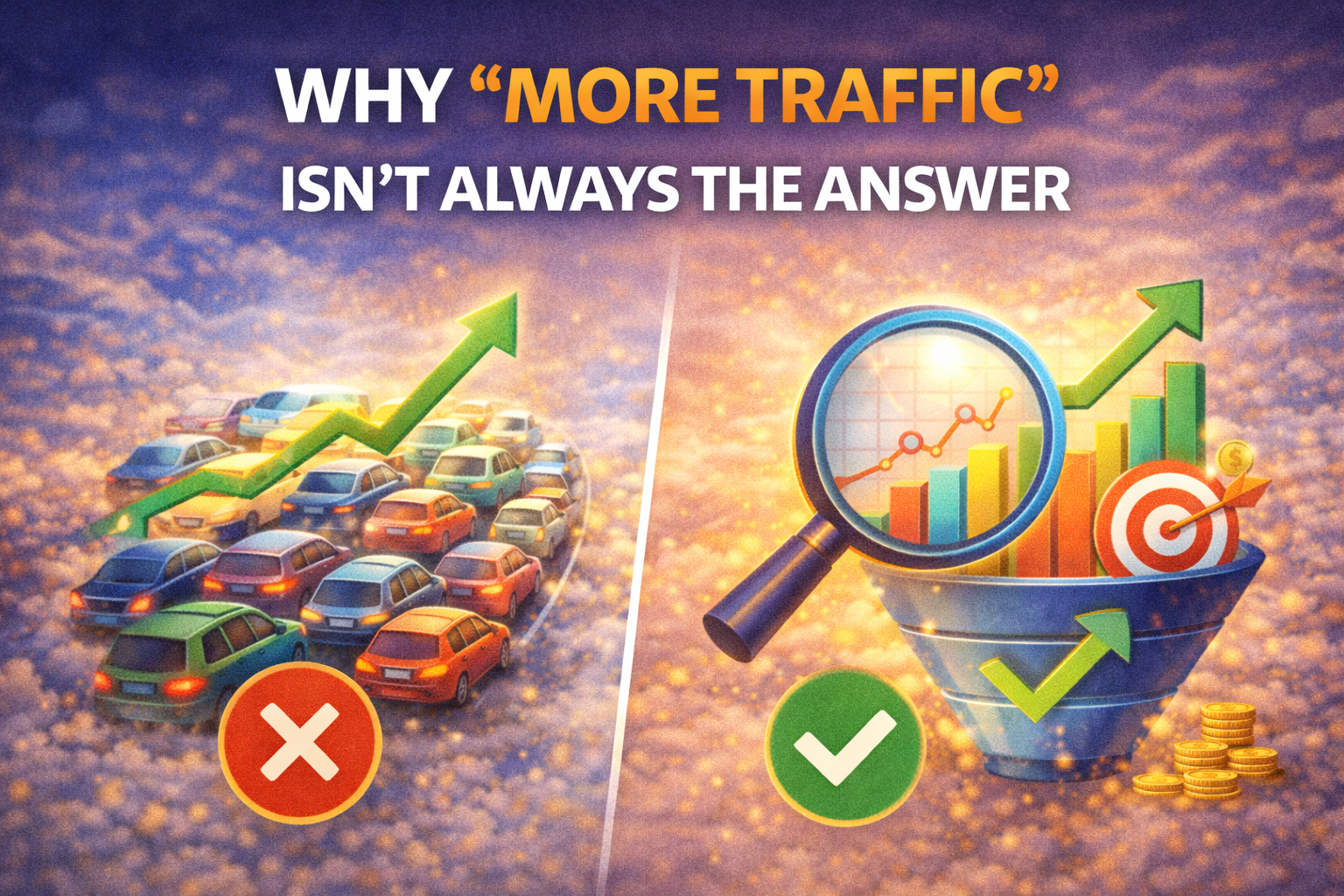
  • Issue #16 Why “More Traffic” Isn’t Always the Answer

    Issue #16 Why “More Traffic” Isn’t Always the Answer

    When something isn’t working in affiliate marketing, the default reaction is usually the same:

    “I just need more traffic.”

    But more traffic doesn’t fix a broken system. In many cases, it actually hides the real problem.


    The Traffic Trap

    Early on, it’s easy to believe that volume solves everything.

    More visitors means more clicks.
    More clicks means more sales.

    Except that’s not how it usually plays out.

    If your message isn’t clear, your offer isn’t aligned, or your next step isn’t obvious, adding more traffic just sends more people away faster.


    Why Traffic Isn’t the First Problem

    Most of the time, the real issue lives before traffic:

    • The page doesn’t clearly explain the benefit
    • The offer doesn’t match the promise
    • The next step isn’t obvious
    • There’s no trust built yet

    Traffic amplifies whatever already exists. If the foundation is weak, traffic magnifies the weakness.


    What to Fix Before Chasing More Visitors

    Before worrying about traffic numbers, focus on these basics:


    1. Message Clarity

    Can someone answer this in five seconds:

    “What is this for, and why should I care?”

    If not, traffic won’t save it.


    2. One Clear Action

    Every page should answer one question:

    “What do you want me to do next?”

    Too many options lead to no action.


    3. Alignment Between Content and Offer

    If your content talks about one problem but your link solves a different one, conversions suffer.

    Traffic expects continuity.


    4. Trust Signals

    People don’t click because you asked. They click because they feel safe doing so.

    That comes from:

    • Consistency
    • Transparency
    • Relevance

    When More Traffic Does Help

    Traffic becomes powerful after the basics are working.

    You’ll know you’re ready when:

    • People are clicking consistently
    • Some visitors opt in
    • Engagement is slowly increasing
    • You can predict what happens next

    At that point, traffic fuels growth instead of frustration.


    A Better Question to Ask

    Instead of:

    “How do I get more traffic?”

    Ask:

    “What happens to people after they arrive?”

    Fix that first.


    Final Thought

    Traffic is a multiplier — not a solution.

    Build something worth multiplying, and even small traffic numbers can produce meaningful results.

    Clarity converts.

  • Issue #11 — Why Most Traffic Plans Fail Before They Start

    Issue #11 — Why Most Traffic Plans Fail Before They Start

    Hey there!

    Most affiliate marketers don’t fail because traffic doesn’t work.

    They fail because they try to do too much, too fast, with no clear system behind it.

    If your traffic efforts feel scattered or inconsistent, this might be why.


    The Real Problem With Most Traffic Plans

    When I first started, my “strategy” looked like this:

    • SEO one week
    • Social posting the next
    • A paid ad experiment right after that

    Nothing had time to work.

    Every time I switched tactics, I reset my momentum — and my confidence.

    What finally changed things wasn’t a new tool or platform.

    It was focus.


    The Lesson That Changed Everything

    Traffic started making sense when I stopped chasing everything and committed to one traffic source at a time.

    Instead of asking:

    “Why isn’t this working yet?”

    I started asking:

    “What can I improve this week?”

    That’s when clicks became predictable — even on a small budget.


    Tip of the Week: The Single-Source Rule

    For your first 30 days, simplify everything:

    1. Choose one traffic method
    2. Send traffic to one main page
    3. Track one metric (clicks, not sales)
    4. Improve one element per week

    Traffic grows when focus replaces chaos.


    Your Action Step Today

    Look at your current setup.

    If it includes:

    • Multiple traffic sources
    • Several different links
    • Too many stats to track

    Strip it down.

    Simple systems scale better — especially when time and money are limited.