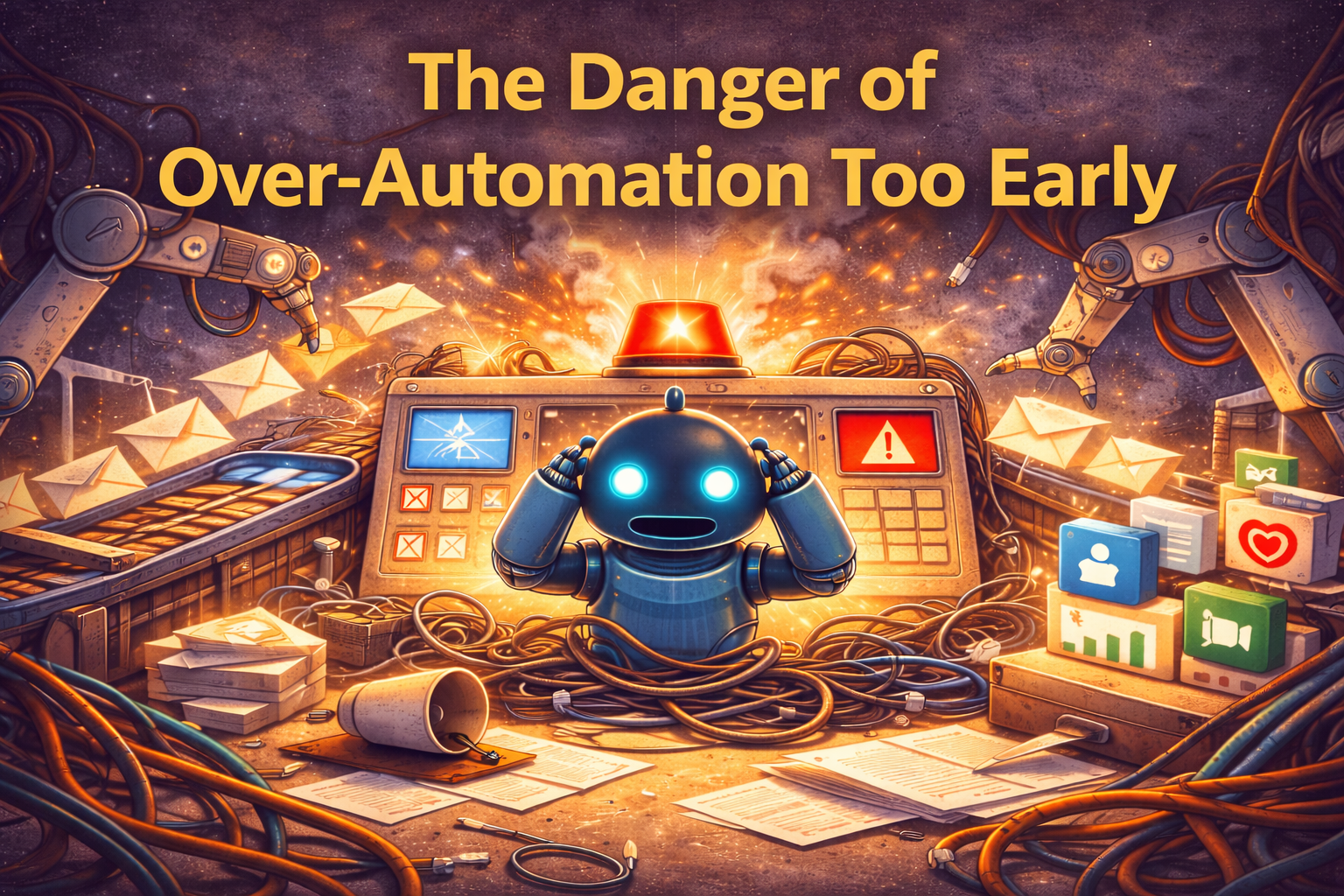
Automation is powerful. It saves time, reduces manual effort, and allows you to scale faster than ever before.
But there’s a hidden trap many founders, marketers, and creators fall into:
They automate before they understand what actually works.
And that mistake can quietly stall growth, burn cash, and disconnect you from your customers.
Let’s talk about why over-automation too early is dangerous — and how to avoid it.
The Seduction of Automation
Today, you can automate:
Email sequences
Lead nurturing
Social media posting
Customer onboarding
Sales follow-ups
Content distribution
Support responses
With a few clicks, your business can look “fully built.”
But looking automated and being effective are two very different things.
Automation multiplies systems. If the system is flawed, automation multiplies the flaws.
Why Early Automation Backfires
- You Haven’t Validated the Process Yet
Before you automate, you need proof:
Which messaging converts?
Which offer resonates?
Where do customers get confused?
What objections come up repeatedly?
If you automate too soon, you lock in guesses instead of insights.
Manual work forces you to pay attention. Automation removes that feedback loop.
- You Lose Customer Intimacy
In the early stages, direct interaction is gold.
When you manually:
Respond to emails
Run sales calls
Handle onboarding
Follow up personally
You gather language, objections, patterns, and emotional triggers.
Automating too early cuts off that learning channel — and that knowledge is often what creates real growth later.
- You Add Complexity Before Revenue
Automation tools come with:
Monthly costs
Integration headaches
Setup time
Maintenance
Hidden edge cases
If revenue isn’t consistent yet, you’re layering complexity on top of uncertainty.
That’s not scaling. That’s building infrastructure for traffic that doesn’t exist yet.
- You Optimize Before You Prove Demand
Many founders build:
10-email nurture sequences
Multi-branch funnels
Complex CRM workflows
…before they’ve even confirmed people want the core offer.
Automation should amplify something that’s already working — not compensate for something that isn’t.
When Automation Does Make Sense
Automation becomes powerful when:
You’ve manually validated the funnel
You understand objections and buyer psychology
Revenue is consistent
The process is repeatable
Bottlenecks are clearly identified
At that point, automation becomes leverage — not distraction.
The Right Order of Operations
Here’s a safer progression:
Manual First Do it yourself. Talk to customers. Test messaging. Refine.
Document What Works Identify patterns and repeatable processes.
Simplify the System Remove unnecessary steps.
Then Automate Only automate what is proven and stable.
Automation should feel like removing friction — not adding moving parts.
A Simple Rule to Remember
If you haven’t:
Closed 20–50 sales manually
Personally handled objections
Seen the funnel convert consistently
It’s probably too early to automate heavily.
Manual effort builds clarity. Clarity builds conversion. Conversion earns the right to automate.
Final Thought
Automation is a multiplier.
If your foundation is strong, it accelerates growth. If your foundation is weak, it accelerates failure.
Build understanding first. Automate second.
That order alone can save you months of frustration.
Leave a Reply