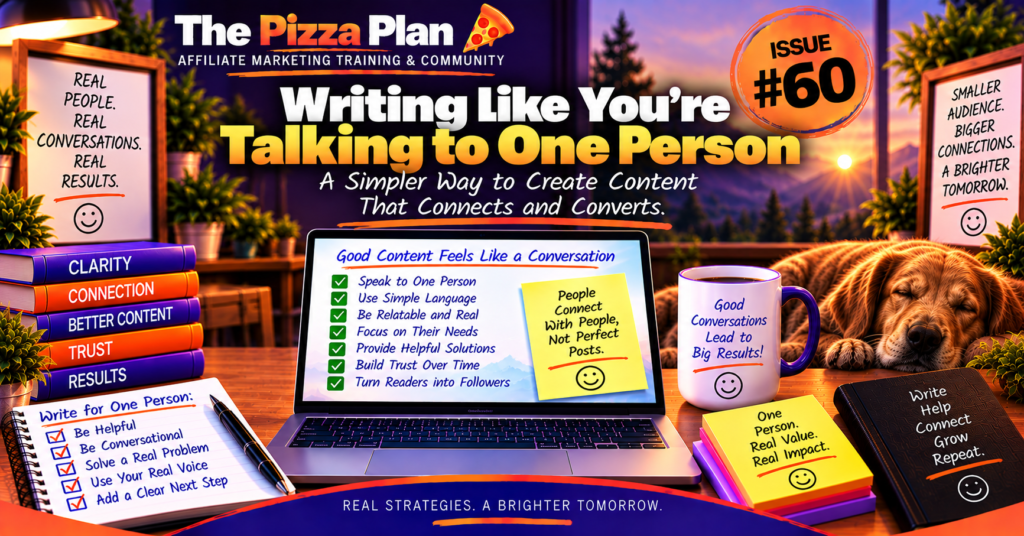
Have you ever sat down to write a blog post or email and suddenly felt like you needed to sound more… professional?
You start changing perfectly normal words into bigger ones. Your sentences get longer. Before you know it, you don’t sound much like yourself anymore.
I’ve found there’s a much simpler way to approach it:
Stop writing to an audience. Write to one person.
Not because only one person will read what you write, of course.
But because every person who does read it will be reading it individually.
They’re not sitting in a stadium with thousands of your subscribers. They’re probably looking at a phone or computer screen by themselves.
So why not write like you’re having a conversation with them?
The Problem With Writing to “Everyone”
When we picture an audience, it’s easy to become overly formal.
We start thinking about what people might want to hear.
What will subscribers think?
What will visitors respond to?
And the bigger that imaginary crowd becomes, the easier it is for our writing to become vague.
Compare that with talking to one person.
If a friend told you they were struggling to get traffic to their affiliate offer, you probably wouldn’t begin with:
“In today’s rapidly evolving digital marketing landscape…”
At least, I hope not. 😄
You’d probably say something more like:
“Okay, what have you tried so far?”
That’s a conversation.
And conversations are much easier to connect with.
Picture One Reader
Before you start writing, imagine one person from your audience.
Maybe they’re a new affiliate marketer who has been working at this for a few months.
They’ve watched plenty of videos.
They’ve joined a few programs.
They’ve tried several traffic methods.
But they’re still wondering whether they’re actually making progress.
Now write to that person.
Suddenly, you don’t need to figure out what to say to thousands of people.
You only need to answer one question:
What would help this person today?
That small shift can make writing much easier.
Focus on One Problem
Trying to solve too many problems in one article usually makes the article harder to follow.
Instead, choose one.
For example:
- How do I get my first subscribers?
- What should I send my email list?
- How do I know whether my traffic is working?
- Do I really need another marketing tool?
- Why am I getting views but no clicks?
One person.
One problem.
One useful conversation.
That’s enough for a good piece of content.
You can always tackle another problem next time.
Use the Words You Would Actually Say
One of the easiest ways to make your writing more conversational is to read it out loud.
If you stumble over a sentence, there’s a good chance your reader will too.
Ask yourself:
Would I actually say this to someone?
If the answer is no, simplify it.
You don’t need complicated marketing language to prove that you know what you’re talking about.
In fact, being able to explain something simply is often far more useful.
Instead of trying to sound impressive, try to be understood.
Talk With Your Reader, Not At Them
There’s another subtle difference that matters.
Good conversational content doesn’t feel like a lecture.
It invites the reader into the discussion.
Questions can help:
Have you run into this?
Does this sound familiar?
What have you tried so far?
You don’t need to fill every article with questions, but occasionally inviting the reader to think about their own situation makes the content feel much more personal.
It turns a monologue into something closer to a conversation.
You Don’t Have to Remove Your Personality
Sometimes we become so focused on creating “good content” that we edit all the personality out of it.
That’s a mistake.
Your readers don’t need another generic marketing textbook.
There are plenty of those already.
They need useful information presented by a real person.
That means it’s okay to have opinions.
It’s okay to admit you’re still learning something.
It’s okay to use humor.
It’s okay to say, “This didn’t work the way I expected.”
Those little moments help readers get to know the person behind the content.
And that matters when you’re trying to build relationships instead of simply generate clicks.
One Reader Can Still Lead to a Larger Audience
Writing to one person doesn’t mean making your content so specific that nobody else can relate to it.
Usually, the opposite happens.
When you clearly describe one person’s problem, thousands of people with the same problem may recognize themselves in what you’ve written.
That’s one of the interesting things about useful content.
Specific can feel more personal without becoming less relevant.
Instead of trying to write something for everybody, create something genuinely helpful for somebody.
Then let the right people recognize that it’s for them too.
Try This Before Your Next Post or Email
Before you start writing, answer these three questions:
- Who am I talking to?
- What problem are they dealing with right now?
- What is the most useful thing I can tell them about it?
Then start writing as though that person just asked you the question.
Forget about algorithms for a minute.
Forget about sounding like an expert.
Forget about trying to impress anyone.
Just help the person on the other side of the screen.
You can polish the article afterward.
Final Thought
It’s easy to forget that behind every pageview, subscriber, click, and email address is an actual person.
And people tend to connect with people.
So the next time you’re staring at a blank page wondering what to write, don’t imagine an audience of thousands waiting for something brilliant.
Imagine one person sitting across the table from you.
What would you tell them?
Start there.
Because some of the best marketing doesn’t feel much like marketing at all.
It feels like a helpful conversation.
Leave a Reply