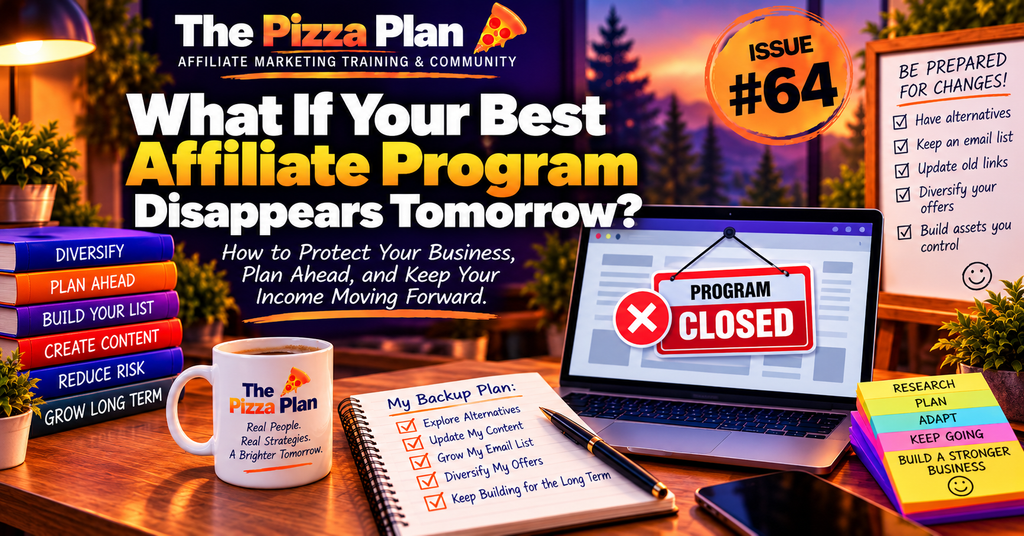
Imagine waking up tomorrow morning, checking your email, and finding a message from your favorite affiliate program.
“We’re sorry to announce that our affiliate program is closing.”
Just like that, one of your income sources is gone.
Maybe the company decided to discontinue its affiliate program. Maybe it drastically reduced commissions. Or perhaps it changed its rules, making it harder for you to promote its products.
Whatever the reason, you’re suddenly facing a problem you hadn’t planned for.
Now here’s the important question:
Would your affiliate business survive?
It’s not the most exciting question to ask, but it’s one worth thinking about—especially if you’re building your business on a limited budget.
Let’s talk about how to protect the work you’re putting in today so one unexpected change doesn’t wipe out your progress tomorrow.
The Problem With Putting All Your Eggs in One Basket
When you’re starting out in affiliate marketing, focusing on one good program can actually be a smart move.
You have limited time, limited money, and probably more than enough things competing for your attention.
Learning one program, understanding its products, and building content around it makes sense.
In fact, we’ve talked before about why promoting everything under the sun usually isn’t a great strategy.
But there’s a difference between focusing on one program and depending entirely on one program.
Focus helps you build momentum.
Dependence creates risk.
If every blog post, email, and promotional campaign you create points to the same affiliate program, what happens when that program changes?
Suddenly, you might have dozens of links to update and content that no longer leads anywhere useful.
And if that program was your only source of affiliate income, the financial impact could be even bigger.
The solution isn’t to join twenty different programs tomorrow.
It’s to build your business in a way that gives you options.
Build Something You Control
Here’s something I think every affiliate marketer should remember:
You don’t own the affiliate programs you promote. But you can build assets that belong to your business.
Think about your blog.
Every useful article you publish has the potential to attract visitors long after you’ve written it.
Now think about your email list.
Those subscribers joined because they wanted something you had to offer. Maybe it was a helpful ebook, a useful tip, or a solution to a problem they were facing.
They didn’t necessarily join because of one particular affiliate program.
They joined because they found value in what you shared.
That’s an important distinction.
If an affiliate program disappears, your blog doesn’t have to disappear with it.
Your email list doesn’t have to disappear either.
You can update your recommendations, introduce a suitable alternative, or create something of your own.
The relationship you’ve built with your audience is more valuable than any single affiliate link.
Of course, your blog and email list still depend on hosting, software, and service providers. That’s why keeping backups and maintaining access to your subscriber data, where permitted, is part of protecting those assets.
Have a Backup Plan Before You Need One
You don’t need a complicated disaster recovery plan for your affiliate business.
Especially when you’re just getting started.
But a little preparation can save you a lot of headaches later.
Here are four simple things you can do.
1. Keep Track of the Programs You Promote
Create a basic spreadsheet listing your affiliate programs.
Include the program name, your affiliate link, commission information, and where you’re promoting it.
You can also note when you last checked that the offer was still available.
This doesn’t have to be fancy.
A simple Google Sheet will do the job.
The goal is to avoid scrambling through old blog posts and emails trying to remember where you placed your links.
2. Know Your Alternatives
You don’t need to actively promote several competing products.
But it helps to know what other options exist.
For example, if you’re promoting an email marketing tool, are there other beginner-friendly services that could meet your audience’s needs?
If your favorite program closes, you won’t be starting your research from scratch.
Just remember that a replacement should be something you genuinely believe will help your readers.
Never recommend an inferior product simply because it offers a commission.
3. Keep Building Your Own Audience
This is where your blog and email list become especially important.
When all your traffic goes directly to someone else’s sales page, you’re depending heavily on that company’s offer and conversion process.
But when you create helpful content and invite visitors to join your email list, you’re building an ongoing relationship.
You have opportunities to help people with more than one problem.
And you’re not forced to start over every time an affiliate offer changes.
Your subscribers should always have a clear way to unsubscribe, and your list should be managed according to applicable email and privacy requirements.
4. Review Your Affiliate Links Regularly
Here’s a simple habit that can prevent future problems.
Once a month, take a few minutes to check your most important affiliate links.
Make sure they still lead to the correct pages.
Check whether the offer is still available and whether any major terms have changed.
You don’t have to review every link on your website in one sitting.
Start with the pages and emails that receive the most attention.
A little maintenance now can prevent wasted traffic later.
What If It Actually Happens?
Let’s say your favorite affiliate program really does close tomorrow.
First, don’t panic.
Take a moment to find out exactly what’s changing.
Is the program closing immediately? Are commissions being reduced? Will existing referrals still earn commissions? Is there a deadline to withdraw your earnings?
Get the facts before making changes.
Then prioritize your next steps.
Start with the links receiving the most traffic.
Update or remove promotions that are no longer valid.
If you have a suitable alternative, explain why you’re recommending it.
And if you don’t have a good replacement yet?
That’s okay, too.
You can still publish useful content while you evaluate your options.
Your audience is better served by an honest explanation than by a rushed recommendation.
Remember, losing an affiliate program doesn’t mean losing everything you’ve built.
The Bigger Picture: You’re Building a Business, Not Just Collecting Commissions
One of the biggest mindset shifts in affiliate marketing happens when you stop thinking only about individual sales.
Instead, you start thinking about the business you’re building.
Your content.
Your skills.
Your audience.
Your reputation.
The systems you develop along the way.
Those things can continue providing value even when individual affiliate programs come and go.
And the more useful your content becomes, the more opportunities you may have to recommend different products, explore new income streams, or eventually offer resources of your own.
That doesn’t mean you need to do everything at once.
In fact, I’d encourage you not to.
Keep things simple.
Focus on helping your audience.
But make sure the foundation you’re building doesn’t depend entirely on decisions made by another company.
A sustainable affiliate business isn’t one where nothing ever goes wrong. It’s one that can adapt when things change.
Your Affiliate Business Backup Checklist
Here’s a quick checklist you can work through this week.
- [ ] List the affiliate programs you’re currently promoting.
- [ ] Record your most important affiliate links and where they’re used.
- [ ] Check whether your primary programs have changed their terms.
- [ ] Research one potential alternative to your main offer.
- [ ] Make sure you have current backups of your important website content and subscriber data, where permitted.
- [ ] Review your highest-traffic affiliate links.
- [ ] Identify one way to strengthen your relationship with your audience that doesn’t depend on making an immediate sale.
You don’t have to complete everything today.
Even checking off one or two items puts you in a stronger position than you were yesterday.
Final Thoughts
Affiliate marketing offers some wonderful opportunities, especially for people who want to start an online business without spending a fortune.
But there’s one thing we should never forget.
Affiliate programs are someone else’s business. Your job is to build yours.
That means creating useful content, developing relationships, and making thoughtful recommendations that serve your audience.
It also means being prepared when things don’t go according to plan.
Because sooner or later, something will change.
A program might close.
A commission rate might drop.
A favorite marketing tool might stop working the way it used to.
You can’t control all those changes.
But you can control how prepared you are for them.
And sometimes, a little preparation makes all the difference.
Until next time, keep building something that lasts!
Leave a Reply