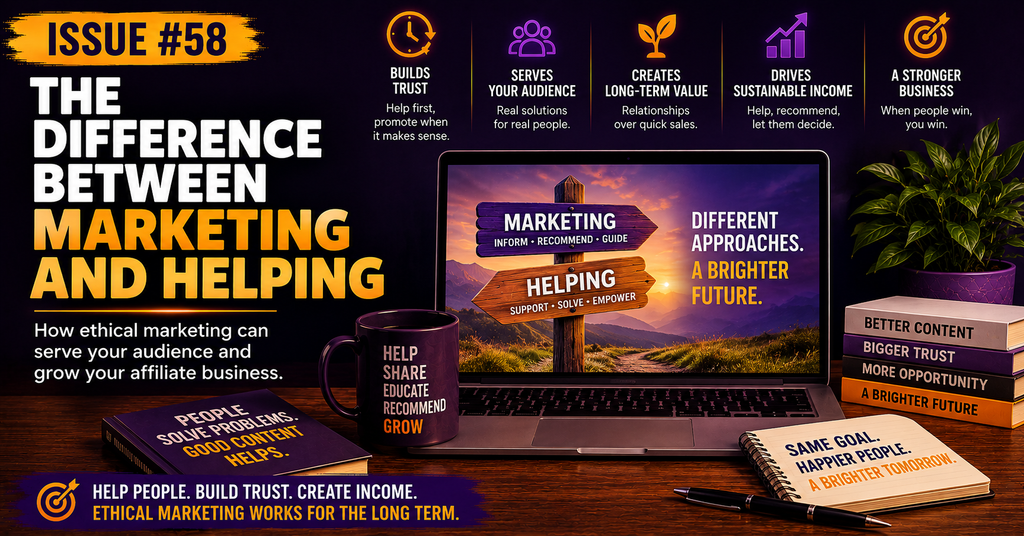
Affiliate marketing can create a strange tension.
You want to help people. You want to publish useful content, answer questions, share what you’re learning, and build trust.
But eventually, you’re also supposed to market something.
And that’s where some affiliate marketers start feeling uncomfortable.
If you’re too promotional, you worry that people will stop trusting you.
But if you avoid promotion completely, you’re building an affiliate business that never actually gives anyone an opportunity to buy.
The problem may be the way we’re thinking about marketing in the first place.
Marketing and Helping Aren’t Opposites
It’s easy to think of helping as the “good” part of the business and marketing as the part where you finally have to start selling.
I don’t think they need to be separated that way.
Good marketing can be a form of helping.
Think about what useful marketing actually does.
It helps someone:
- Recognize a problem they’re dealing with
- Understand that problem better
- Discover possible solutions
- Decide which solution might fit their situation
- Understand the advantages and limitations
- Take the next step when they’re ready
That’s very different from throwing an affiliate link at someone and hoping they click it.
Start With the Problem, Not the Product
One of the easiest ways to tell whether you’re helping or simply promoting is to look at where you’re starting.
Are you starting with:
“I have this product. How can I get people to buy it?”
Or are you starting with:
“My audience has this problem. What would actually help them solve it?”
Those questions can lead to very different content.
When the product comes first, there’s a temptation to make every problem somehow lead back to whatever you’re promoting.
When the audience comes first, the recommendation has to earn its place.
Sometimes the right answer might be an affiliate product.
Sometimes it might be a free resource.
Sometimes it might be one of your own resources.
And sometimes the most useful thing you can tell someone is simply, “You don’t need to buy anything yet.”
That’s still marketing done well because you’re building something more valuable than a single click.
You’re building trust.
But Helping Doesn’t Mean You Can Never Sell
There’s another side to this.
Some marketers become so focused on providing value that they become uncomfortable making an offer at all.
They’ll write the article.
Explain the problem.
Give useful advice.
Help the reader understand what to do.
And then…stop.
No recommendation. No next step. No invitation to learn more.
There’s nothing wrong with content that doesn’t promote anything. Not every post needs an affiliate offer attached to it.
But if you know about a resource that could genuinely help someone solve the problem you’re discussing, telling them about it isn’t automatically pushy.
It may actually be the most useful next step.
The difference is why the recommendation is there.
Is it there because you need somewhere to put your affiliate link?
Or is it there because it makes sense for the person reading the article?
That’s a much better question.
Give People Enough Information to Decide
Helping doesn’t mean making the decision for someone.
Your job isn’t to convince every reader that a particular product is perfect for them.
It’s to help the right reader decide whether it’s worth considering.
That means talking about benefits without pretending there are no drawbacks.
It means explaining who something is for—and sometimes who it isn’t for.
It means being clear about costs when they’re relevant.
And it means resisting the temptation to turn every recommendation into:
“You NEED this!”
Most of the time, people don’t need more pressure.
They need clarity.
The Best Marketing Connects the Dots
Imagine someone comes to your blog because they’re struggling to get traffic.
You publish an article that helps them understand why their current traffic strategy isn’t working.
That’s helping.
You explain a simple way they can improve it.
Still helping.
You mention a tool or resource that could make part of that process easier.
Now you’re marketing.
But did you suddenly stop helping?
Not necessarily.
If the recommendation genuinely fits the problem you’ve been discussing, the marketing is simply continuing the conversation.
Problem → Understanding → Possible Solution → Next Step
That’s a much healthier way to think about affiliate marketing than:
Traffic → Affiliate Link → Hopefully a Commission
Trust and Income Don’t Have to Compete
This is one of the biggest lessons I’m continuing to build the Affiliate Success Journal around.
We don’t have to choose between building trust and building income.
The goal is to build them together.
That means helping before promoting when that’s what the reader needs.
It means making an offer when an offer genuinely makes sense.
And it means being willing to recommend nothing when nothing is the best fit.
Ironically, being selective about when you market can make your marketing more meaningful.
When readers learn that you don’t recommend something every five minutes, the recommendations you do make carry more weight.
A Simple Question Before You Promote
Before adding a promotion to your next blog post, email, or piece of content, ask yourself:
“If I weren’t earning a commission from this, would recommending it still make sense here?”
You don’t have to pretend the commission doesn’t matter.
This is a business. Making money matters.
But the commission shouldn’t be the only reason the recommendation exists.
If the offer solves the problem, fits the audience, and gives the reader a useful next step, there’s nothing wrong with getting paid when someone chooses it.
That’s how affiliate marketing is supposed to work.
The Bottom Line
Helping without ever making an offer can leave people without a next step.
Marketing without genuinely helping gives them no reason to trust the offer.
The best affiliate marketing does both.
Help people understand their problems.
Give them useful information.
Recommend solutions when they genuinely fit.
And then let people decide for themselves.
That’s not choosing between helping and marketing.
That’s making helping part of how you market.
Leave a Reply